
How does the weekend catch-up sleep ratio affect the health and lifestyle of Korean adults? An age- and sex- matched study
Data files
May 27, 2024 version files 151.71 KB
Abstract
The purpose of this study was to investigate the association between various levels of physical activity, self-perception, cardiometabolic risk factors, and weekend catch-up sleep ratio (CSR). Using raw data from the Korea National Health and Nutrition Examination Survey 2018 – 2021, all participants were divided into three groups (< 1.0, 1.0 ≤ CSR < 1.5, or ≥ 1.5) by CSR, which is the value calculated by dividing weekend sleep time by weekday sleep time. After matching age and sex, 2,484 Korean adults were selected as study participants. Descriptive statistics, chi-square test, ANOVA, and multinomial logistic regression analysis were performed to analyze the data. The results showed a significant association between weekend CSR and socioeconomic status, physical activity, self-perception levels, and cardiometabolic risk factors. Specifically, compared to the reference group (1 ≤ CSR < 1.5), those with a CSR < 1 were 2.42 times more likely to live in a single-family house (OR = 2.42, 95% CI = 1.77 – 3.32) and 1.71 times more likely to engage in vigorous physical activity meeting WHO guidelines (OR = 1.71, 95% CI = 1.20 – 2.46). They were also 1.33 times more likely to perceive themselves as 'obese' (OR = 1.33, 95% CI = 1.00 – 1.76). Conversely, those in the CSR ≥ 1.5 group were 3.93 times more likely to be 'pink-collar' workers (OR = 3.93, 95% CI = 2.70 – 5.71), 1.72 times more likely to perceive their stress levels as 'quite' (OR = 1.72, 95% CI = 1.20 – 2.47), and 1.87 times more likely to have diabetes (OR = 1.87, 95% CI = 0.97 – 3.60). Alterations in CSR could indicate changes in physical activity levels, sedentary behavior duration, and other health indicators, ultimately influencing overall well-being. Therefore, a comprehensive healthcare approach incorporating CSR considerations is increasingly essential.
https://doi.org/10.5061/dryad.0p2ngf285
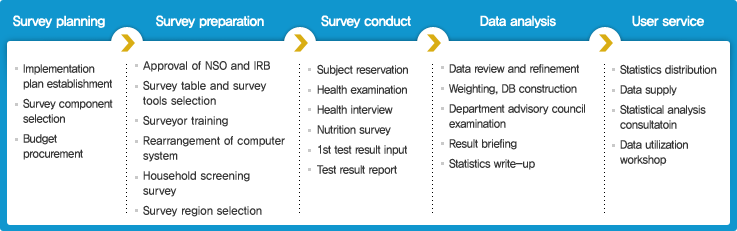
Descriptions
The KNHANES is a comprehensive national survey implemented across South Korea. Its primary objective is to consistently accumulate data annually encompassing various elements, including sociodemographic indicators, economic status, and health-related characteristics and behaviors across all age demographics. Since 2007, this body of data has undergone review and received an annual endorsement by the Research Ethics Review Committee from the Korea Centers for Disease Control and Prevention Agency (KDCA). The KNHANES data is an open-access resource for scholars, enabling further exploratory analysis and research in numerous fields.
We removed and masked (categorized) individual pieces of data to avoid harming the integrity of the dataset. (Age, Height, Weight, Waist circumference, Residential type, Income quintile, Housing type, Subjective health status, Occupational classification, Subjective body shape perception, Drinking and smoking status, Perceived daily stress, Participated time of physical activity, Average sleep time per day during the week and weekend)
- ID: Identification
-
CSR: Catch-up Sleep Ratio
CSR_T: Catch-up Sleep Ratio Tertile
- year: Survey year
-
sex: Sex
{1 = Male, 2 = Female}
age: Age
{1 = 20's, 2 = 30's, 3 = 40's, 4 = 50's, 5 = 60's, 6 = 70's, 7 = 80's}
-
live_t: Housing type
{1 = Single family, 2 = Apartment, 3 = Others}
-
EC_occp: (Employed) Occupational classification
{1 = Whithe collar, 2 = Pink collar, 3 = Blue collar, 4 = Not calssified}
-
Total_slp_wk: Average number of hours of sleep per day during the week
{1 = Hours < 4, 2 = 4 ≤ Hours < 6, 3 = 6 ≤ Hours <8, 4 = 8 ≤ Hours < 10, 5 = 10 < Hours}
Total_slp_wd: Average number of hours of sleep per day on weekends
{1 = Hours < 4, 2 = 4 ≤ Hours < 6, 3 = 6 ≤ Hours <8, 4 = 8 ≤ Hours < 10, 5 = 10 < Hours}
-
BE3_73: Work_Vigorous Physical Activity (hours)
{1 = Hours < 3, 2 = 3 ≤ Hours < 6, 3 = 6 ≤ Hours}
BE3_74: Work_Vigorous physical activity (minutes)
{1 = Minutes < 20, 2 = 20 ≤ Minutes < 40, 3 = 40 ≤ Minutes}
BE3_83: Days_Moderate Physical Activity (hours)
{1 = Hours < 3, 2 = 3 ≤ Hours < 6, 3 = 6 ≤ Hours}
BE3_84: Daily_Moderate Physical Activity (minutes)
{1 = Minutes < 20, 2 = 20 ≤ Minutes < 40, 3 = 40 ≤ Minutes}
BE3_93: Movement_Physical Activity Time (hours)
{1 = Hours < 3, 2 = 3 ≤ Hours < 6, 3 = 6 ≤ Hours}
BE3_94: Movement_Physical Activity Time (minutes)
{1 = Minutes < 20, 2 = 20 ≤ Minutes < 40, 3 = 40 ≤ Minutes}
BE3_77: Leisure_Vigorous Physical Activity Time (hours)
{1 = Hours < 3, 2 = 3 ≤ Hours < 6, 3 = 6 ≤ Hours}
BE3_88: Leisure_Moderate Physical Activity (min)
{1 = Minutes < 20, 2 = 20 ≤ Minutes < 40, 3 = 40 ≤ Minutes}
-
BE8_1: Time spent sitting on a typical day (hours)
{1 = Hours < 3, 2 = 3 ≤ Hours < 6, 3 = 6 ≤ Hours}
BE8_2: Time spent sitting on a typical day (minutes)
{1 = Minutes < 20, 2 = 20 ≤ Minutes < 40, 3 = 40 ≤ Minutes}
-
HE_wc: Waist circumference
{1 = WC < 70cm, 2 = 70cm ≤ WC < 90cm, 3 = 90cm ≤ WC < 110, 4 = 110cm ≤ WC}
HE_BMI: Body Mass Index
{1 = BMI < 20, 2 = 20 ≤ BMI < 25, 3 = 25 ≤ BMI < 30, 4 = 30 ≤ BMI}
-
HE_glu: Fasting blood glucose
{1 = Normal, 2 = Borderline, 3 = Dangerous}
HE_HbA1c: Glycated hemoglobin
{1 = Normal, 2 = Borderline, 3 = Dangerous}
HE_chol: Total cholesterol
{1 = Normal, 2 = Borderline, 3 = Dangerous}
HE_TG: Triglycerides
{1 = Normal, 2 = Borderline, 3 = Dangerous}
-
Sharing/Access information
Links to other publicly accessible locations of the data:
Data was derived from the following sources:
This cross-sectional study used data from the Korea National Health and Nutrition Examination Survey (KNHANES) during 2018 – 2021. The KNHANES is a comprehensive national survey implemented across South Korea. Its primary objective is to consistently accumulate data annually encompassing various elements, including sociodemographic indicators, economic status, and health-related characteristics and behaviors across all age demographics. Since 2007, this body of data has undergone review and received an annual endorsement by the Research Ethics Review Committee from the Korea Centers for Disease Control and Prevention Agency (KDCA). The KNHANES data is an open-access resource for scholars, enabling further exploratory analysis and research in numerous fields.
The KNHANES for 2018 – 2021 was conducted with 30,551 respondents. However, 5,616 individuals under 20 years were excluded from the data to align with the research parameters. In addition, participants who did not respond to the critical variables under examination were also eliminated from consideration. The remaining participants were classified into three distinct groups according to their CSR (Group A: CSR < 1, Group B: 1 ≤ CSR < 1.5, Group C: 1.5 ≤ CSR). These groups contained Group A=1,112, Group B=18,743, and Group C=1,233 participants, respectively. Then, we matched participants based on age and sex, using the group A, which had the smallest sample size as the reference group. As a result of this stringent selection process, a balanced cohort of 828 participants from each group was extracted, resulting in a total study sample of 2,484 individuals.
- Hwang, In-Whi; Hwang, Soo-Ji; Shen, Jun-Hao et al. (2023). How does the weekend catch-up sleep ratio affect the health and lifestyle of Korean adults? An age- and gender- matched study [Preprint]. Cold Spring Harbor Laboratory. https://doi.org/10.1101/2023.09.04.23295027